
Insights
What Is HIPAA-Aware Architecture? A Guide for Healthcare AI Platforms
- Healthcare IT
- Compliance
HIPAA-aware architecture is a system design approach that builds the HIPAA Security Rule's required safeguards — access control, encryption, audit logging, and signed Business Associate Agreements — directly into a healthcare application's infrastructure, so that electronic protected health information (ePHI) stays protected at every layer rather than being bolted on afterward.
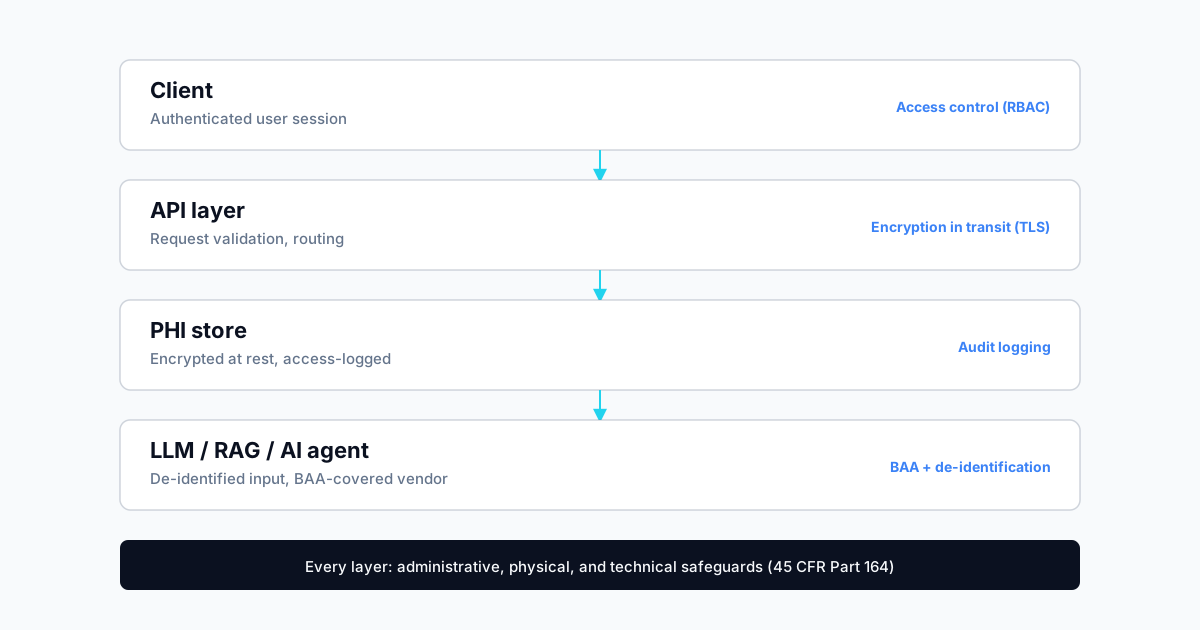
Teams building or scoping a healthcare AI platform usually run into the same question early: where does HIPAA actually touch the architecture, and where is it just a policy document? This guide walks through what HIPAA-aware architecture means in practice, the technical safeguards it requires, when a Business Associate Agreement (BAA) is needed, and how to handle PHI when the platform includes LLMs, retrieval-augmented generation (RAG), or autonomous AI agents.
What does "HIPAA-aware architecture" actually mean?
HIPAA-aware architecture means the system is designed, from the first infrastructure diagram, around the safeguards the HIPAA Security Rule requires — not retrofitted once an auditor asks about them. That distinction matters because HIPAA is not a checklist you complete once; it's a set of administrative, physical, and technical safeguards (45 CFR §164.308, §164.310, §164.312) that has to hold up under how the system actually behaves in production, including how an AI component accesses data.
It's worth being precise about one thing: there is no official "HIPAA certified" status. No government body issues a HIPAA certificate for a platform, a vendor, or a piece of software. Any product claiming to be "HIPAA certified" is using the phrase loosely. What exists instead is a demonstrable state of compliance — safeguards implemented, documented, and maintained — which is what "HIPAA-aware architecture" is describing.
What technical safeguards must a healthcare AI platform implement?
The Security Rule names five specific technical safeguards (45 CFR §164.312): access control, audit controls, integrity controls, person/entity authentication, and transmission security. For a healthcare AI platform, three of these carry the most architectural weight.
Access control and authentication
Every component that can reach ePHI — including an AI agent or a background job — needs to authenticate as a specific identity and operate under least-privilege permissions. Role-based access control (RBAC) is the common pattern: a support tool, a billing service, and an AI assistant should each hold distinct, scoped credentials rather than a shared service account. If an AI agent only needs to read de-identified summaries, its credentials shouldn't be capable of querying the raw PHI store.
Encryption in transit and at rest
HIPAA describes encryption as an "addressable" implementation specification (§164.312(a)(2)(iv) for data at rest, §164.312(e)(2)(ii) for data in transit), not a flatly "required" one. In practice, addressable does not mean optional — it means you must either implement the safeguard or document, in writing, why an equivalent alternative meets the same protection standard. Very few organizations have a defensible reason not to encrypt ePHI in transit (TLS) and at rest (disk- or field-level encryption), so in practice this functions as a baseline expectation.
Audit logging — including every AI-agent access to PHI
Audit controls (§164.312(b)) require hardware, software, or procedural mechanisms that record and examine activity in systems containing ePHI. For an AI-enabled platform, this has to extend to the AI layer itself: every time an agent, a RAG pipeline, or a model-serving call reads, writes, or transmits data that touches PHI, that access needs to be logged with enough detail to reconstruct who (or what process) accessed which record, when, and why. An AI agent that queries a PHI store without generating an audit trail is a gap auditors will find.
Do you need a Business Associate Agreement (BAA) with your AI and cloud vendors?
Yes — a Business Associate Agreement is required before any vendor creates, receives, maintains, or transmits PHI on your behalf (45 CFR §164.502(e), §164.308(b)). This applies to your cloud infrastructure provider and to any AI or LLM vendor whose service will process PHI, including inference calls made from a RAG pipeline or an agent framework.
Major cloud providers publish HIPAA-eligible services and will sign a BAA covering them. AI vendor terms move faster and vary by product tier, so confirm the current BAA coverage for the specific model or API endpoint you plan to use — not just the vendor's brand name — at build time, since this is exactly the kind of detail that changes between when an architecture is drafted and when it ships.
Signing a BAA does not, by itself, make a platform compliant. It is a legal prerequisite for sending PHI to that vendor at all; the technical safeguards above still have to be implemented on top of it.
How do you handle PHI when using LLMs, RAG, and AI agents?
The safest default is to keep PHI out of model calls entirely wherever the use case allows it. Where a use case genuinely requires PHI to inform a model's output, HIPAA requires either a BAA covering that specific processing or de-identification before the data reaches the model.
De-identify before sending data to a model where possible
HIPAA recognizes two de-identification methods (§164.514(b)):
- Safe Harbor — remove 18 specified categories of identifiers (names, dates more specific than year, contact details, medical record numbers, device identifiers, and others) from the data set.
- Expert Determination — a qualified statistician or expert formally determines that the risk of re-identification is very small, using accepted analytic methods.
Data that meets either standard is no longer considered PHI under HIPAA. For a RAG pipeline, that means de-identifying documents before they're embedded into a retrieval index wherever the retrieval use case doesn't specifically require patient-identifying context. For an AI agent that must work with identified data — for example, to look up a specific patient's record — the safeguards above (scoped access control, encryption, audit logging) and a vendor BAA become the controlling requirements instead of de-identification.
HIPAA-aware architecture checklist for healthcare AI platforms
- Every component that can reach ePHI authenticates under a distinct, least-privilege identity
- Role-based access control is enforced for AI agents and services, not just human users
- ePHI is encrypted in transit (TLS) and at rest, or an equivalent alternative is documented
- Audit logging captures every access to ePHI, including AI-agent and model-serving calls
- A signed BAA is in place with every vendor — cloud and AI — that will touch PHI
- BAA coverage is verified for the specific model or API tier in use, not assumed from the vendor's general terms
- Data is de-identified (Safe Harbor or Expert Determination) before reaching a model wherever the use case allows it
- The "minimum necessary" standard (§164.502(b)) is applied — components and agents only receive the PHI fields they need
Where AlphaTek fits
Architecting a compliant healthcare AI platform is a joint effort between the safeguards above and the infrastructure they run on. If you're scoping or reviewing the technical foundation for a healthcare AI platform, AlphaTek's healthcare IT services cover systems and infrastructure support for healthcare organizations — get in touch to talk through your environment.
For the primary source text behind the safeguards discussed here, see the HHS HIPAA Security Rule summary and the full regulatory text at 45 CFR Part 164.
HIPAA is enforced by the HHS Office for Civil Rights (OCR), which can levy civil monetary penalties on a tiered, inflation-adjusted schedule — check HHS.gov directly for the current penalty figures rather than relying on a remembered number, since they're adjusted periodically.
Frequently asked questions
- Is HIPAA compliance the same as HIPAA certification?
- No. There is no official government HIPAA certification. Compliance is demonstrated by implementing the required safeguards and documentation, not by earning a certificate.
- Can I send PHI to OpenAI or ChatGPT?
- Only under a signed Business Associate Agreement covering that use. Without a BAA, PHI must be de-identified before it reaches the model. Verify each vendor's current BAA terms at build time.
- Is encryption required under HIPAA?
- Encryption is an "addressable" implementation specification, not a flat requirement — you must implement it or document a reasonable, equivalent alternative. In practice, encrypting ePHI in transit and at rest is the expected standard.
- What is the difference between the HIPAA Privacy Rule and the Security Rule?
- The Privacy Rule governs who may access and disclose PHI in any form. The Security Rule governs the administrative, physical, and technical safeguards that protect ePHI specifically.
- Does using a HIPAA-eligible cloud provider make my app HIPAA compliant?
- No. The provider offers a BAA and eligible services, but compliance still depends on how you configure and use them — access controls, logging, encryption, and your own policies.